
Roth TSP vs. Traditional TSP for Federal Employees


Choosing between a Roth TSP and traditional TSP comes down to a tax question: should you pay income tax on your contributions now or when you withdraw the money? For federal employees, the answer depends on more than today’s salary. Your FERS pension, Social Security, spouse’s income and retirement date all affect the comparison.
Neither option is automatically better. The goal is to build the most useful after-tax retirement income while preserving enough flexibility to handle changing tax rates and spending needs.
The difference is when you pay income tax
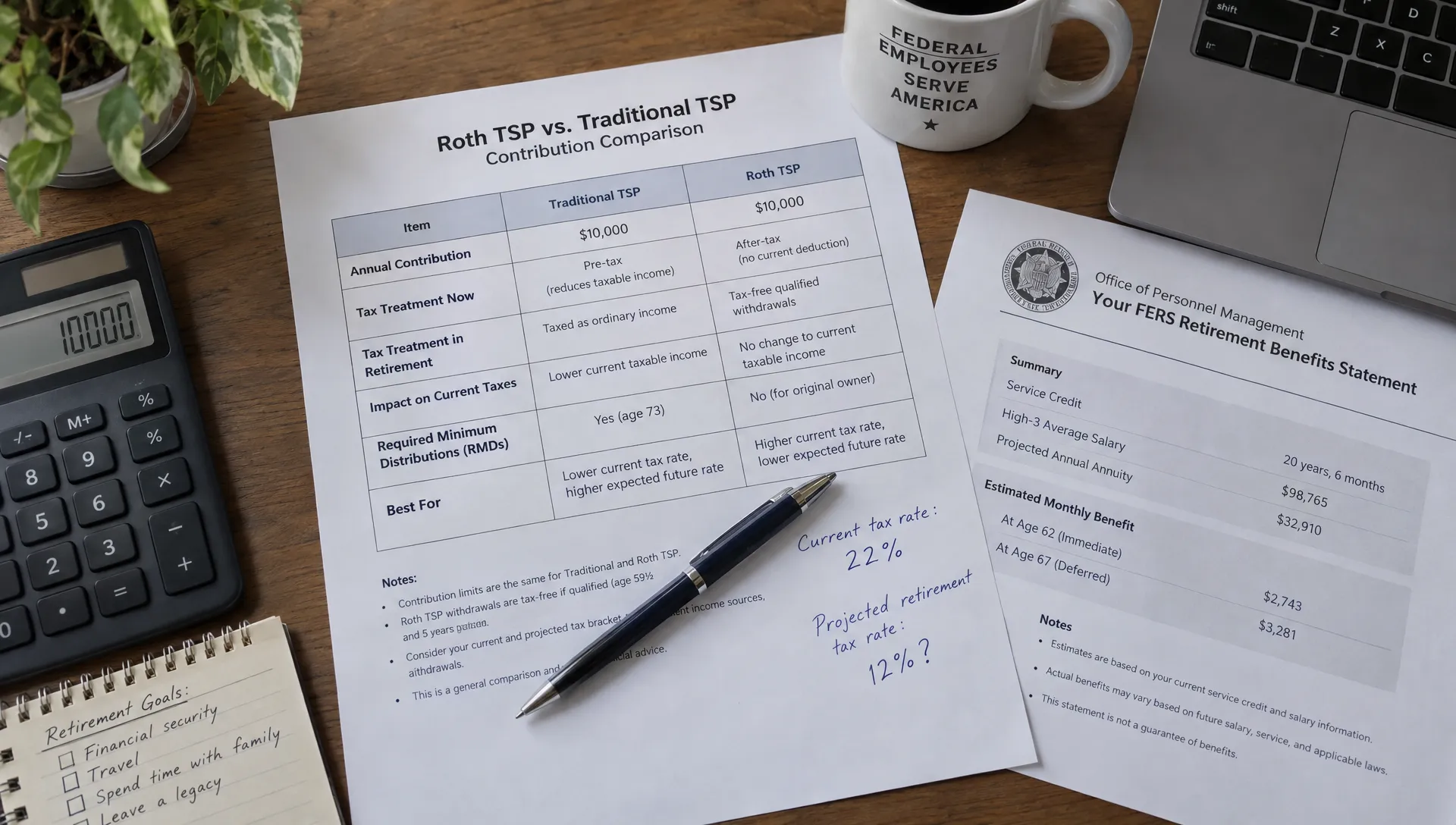
Traditional contributions generally reduce your current federal taxable income. You defer income tax on those contributions and their earnings until withdrawal. Roth contributions come from income you have already paid tax on, but qualified withdrawals, including earnings, are tax-free.
Both are tax treatments within the same Thrift Savings Plan, not separate investment strategies. Choosing one does not give you access to different TSP funds or change the market risk of those funds.
| Feature | Traditional contributions | Roth contributions |
|---|---|---|
| Current federal income tax | Generally reduce taxable income | Do not reduce taxable income |
| Tax on retirement withdrawals | Generally taxable as ordinary income | Tax-free if the distribution is qualified |
| Income limit for contributing | No income-based eligibility limit | No income-based eligibility limit |
| Employee contribution limit | Shared annual limit across both types | Shared annual limit across both types |
| Required minimum distributions during your lifetime | Generally required when applicable | Not required |
Traditional contributions generally do not reduce Social Security or Medicare payroll taxes. Their immediate benefit is primarily the income-tax deduction.
Unlike a Roth IRA, a Roth TSP has no income-based eligibility restriction. A high salary does not prevent you from making Roth payroll contributions, although annual contribution limits still apply. The TSP’s explanation of traditional and Roth contributions provides the official framework.
Keep the full agency match, regardless of tax choice
Eligible FERS employees can receive the full agency contribution while directing all their own contributions to Roth. Choosing a Roth TSP does not eliminate your matching benefit.
Under the standard FERS contribution structure, your agency provides an automatic contribution equal to 1% of basic pay. It also matches the first 3% you contribute dollar for dollar and the next 2% at 50 cents per dollar. Contributing 5% of basic pay therefore generates another 5% from the agency, including the automatic contribution.
Not every federal employee has the same eligibility. CSRS employees, for example, generally do not receive agency matching contributions.
Your contribution election and the tax treatment of agency money are separate. Agency contributions generally go into the traditional balance, even when your own contributions are Roth. That can leave you with both tax treatments without splitting your payroll election.
The timing also matters. To receive the full available match, eligible employees generally need to contribute at least 5% each pay period. Reaching the annual employee contribution limit too early can leave later pay periods without matching contributions. Coordinate your annual savings goal with your payroll calendar rather than front-loading contributions without checking the consequences.
When a Roth TSP can make more sense
Roth contributions are often attractive when your current marginal income-tax rate is lower than the rate you expect to face on future withdrawals. That situation can arise early in a federal career, during a temporarily lower-income year or before a substantial promotion.
Your marginal rate is the rate applied to your next dollar of taxable income, not your average tax rate across all income. It is usually the more useful starting point for this decision.
Federal retirement benefits can also support a case for paying tax now. The taxable portion of a FERS pension, Social Security benefits and traditional-account withdrawals may keep retirement taxable income higher than expected. A lower retirement salary does not necessarily mean a lower retirement tax bracket.
Roth savings also provide flexibility. A qualified withdrawal can help fund a major purchase without adding that withdrawal to federal taxable income. That may be useful when managing the taxation of Social Security benefits or income-related Medicare premiums.
Still, Roth is not automatically preferable simply because retirement is decades away. A long investment horizon benefits both contribution types. The comparison depends on tax rates and how much you can afford to save after accounting for today’s taxes.
When traditional contributions can be the stronger choice
Traditional contributions may be more valuable than a Roth TSP when your current tax rate is relatively high and you expect lower-tax withdrawal opportunities later.
Consider a federal employee in peak earning years whose spouse also earns a substantial salary. A current deduction could be valuable, especially if the household expects several years of lower income after retirement and before Social Security or required minimum distributions begin.
Cash flow matters too. Because traditional contributions generally reduce current income tax, they cost less in take-home pay than the same dollar contribution to Roth. That difference may help you save more while maintaining an emergency reserve or paying down expensive debt.
The deduction only helps your long-term plan if you use the cash-flow benefit productively. Comparing identical contribution amounts without accounting for their different effects on take-home pay can make Roth look better than it is.
State taxes deserve a separate look, particularly for employees working in Maryland, Virginia or DC who expect to retire elsewhere. Current deductions and future retirement-income taxes may be treated differently depending on where you live.
Compare equal take-home costs, not just equal contributions
A fair Roth TSP comparison starts with the same reduction in your household’s spendable income.
Suppose your current marginal federal income-tax rate is 24%. A $6,000 traditional contribution reduces take-home pay by approximately $4,560 after accounting for $1,440 in federal income-tax savings. A $4,560 Roth contribution has the same immediate take-home cost.
Assume each contribution hypothetically doubles before withdrawal. The traditional balance becomes $12,000 and the Roth balance becomes $9,120.
| Tax rate applied to the traditional withdrawal | Traditional balance after tax | Qualified Roth withdrawal |
|---|---|---|
| 12% | $10,560 | $9,120 |
| 24% | $9,120 | $9,120 |
| 32% | $8,160 | $9,120 |
These are simplified illustrations, not investment projections. They ignore state taxes, fees and interactions with other tax provisions, and assume the Roth withdrawal is qualified.
The lesson is straightforward: with equal take-home costs, equal growth and equal contribution and withdrawal tax rates, the two approaches produce the same after-tax result. A lower withdrawal tax rate favors traditional contributions; a higher rate favors Roth.
The comparison changes if you can afford to reach the annual contribution limit either way. The same maximum contribution held in Roth represents more after-tax retirement money, but it also requires paying more tax from current resources.
Understand withdrawal rules before counting on tax-free income
A Roth TSP withdrawal is generally qualified when both requirements are satisfied: the five-tax-year holding period has been met and the distribution occurs at age 59½ or later, after qualifying disability or after death.
The holding period generally starts January 1 of the year of your first Roth contribution to the TSP. A Roth IRA has separate rules, so do not assume that owning one automatically satisfies the TSP’s holding-period requirement.
Early retirement creates a separate planning issue
Federal employees who retire before age 59½ need to distinguish penalty exceptions from Roth qualification rules. Separating from service in or after the calendar year you turn 55 can allow an exception to the additional 10% early-distribution tax on TSP withdrawals. Certain qualifying public-safety employees have earlier exceptions.
That exception does not automatically make Roth earnings tax-free. A nonqualified Roth distribution generally contains a proportional share of contributions and earnings. This differs from the Roth IRA ordering rules that generally allow contributions to come out first.
For an early retiree, having traditional money available for bridge spending can therefore be useful. Your TSP withdrawal strategy should account for access rules as well as tax brackets.
Lifetime distribution requirements differ
Designated Roth accounts no longer require distributions during the original owner’s lifetime. Traditional balances remain subject to required minimum distribution rules when applicable, and beneficiaries face separate requirements. The IRS required minimum distribution FAQs explain the distinction.
Build the decision around your federal retirement timeline
Instead of choosing a permanent percentage based only on your age, map your expected income across several stages. A Roth TSP election that fits your early career may not be the best election during peak household earnings.
During working years, estimate the deduction available from traditional contributions using your household’s marginal federal and state tax rates. Include your spouse’s income and filing status rather than looking only at your federal salary.
Next, estimate retirement income before account withdrawals. Include the taxable portion of your pension, anticipated Social Security and other recurring income. Then identify years when taxable income could be lower, such as the period between leaving federal service and starting Social Security.
Those lower-income years may create opportunities to withdraw traditional funds or convert some pretax savings to Roth at a manageable tax cost. A future conversion is not guaranteed to be advantageous, but the opportunity belongs in the comparison.
Finally, test the plan against a few plausible outcomes: earlier retirement, a spouse continuing to work or a move to another state. Splitting contributions can be reasonable when the preferred answer changes across scenarios. It creates tax flexibility, though a 50/50 split is a starting point rather than a proven optimum.
Check contribution and conversion rules for 2026
Annual contribution limits apply across your traditional and Roth TSP employee contributions combined. Choosing both does not create a second employee contribution allowance. Agency contributions generally do not use up your employee elective-deferral limit, although separate overall plan limits apply.
Beginning in 2026, certain higher-paid employees must make catch-up contributions as Roth contributions under federal rules. That requirement does not mean all their regular contributions must be Roth. Review your agency’s payroll instructions and the IRS catch-up contribution guidance before setting your election.
Also distinguish future contributions from existing savings. Changing your payroll election does not convert your accumulated traditional balance. If you are considering a conversion, review current TSP procedures and estimate the additional taxable income first. Converting a large balance in one year can undermine the tax benefit you hoped to achieve.
Revisit your election after promotions, marriage, a spouse’s employment change or a substantial shift in your retirement date.
Frequently asked questions
Is a Roth TSP better than a traditional TSP? Neither is universally better. Roth generally becomes more attractive when you expect a higher tax rate on future withdrawals. Traditional contributions generally become more attractive when the current deduction is worth more than the tax you expect to pay later.
Do I still get the 5% agency contribution if I contribute entirely to Roth? Yes, if you are eligible for standard FERS agency contributions and contribute at least 5% of basic pay each pay period. The agency’s total includes a 1% automatic contribution and up to 4% in matching contributions. Your Roth election does not remove that eligibility.
Can I contribute to both types at the same time? Yes. You can divide employee contributions between traditional and Roth, subject to the combined annual employee contribution limit. Your allocation can change as your financial circumstances change.
Are Roth withdrawals always tax-free? No. Qualified distributions are tax-free, but the earnings portion of a nonqualified distribution can be taxable. Age, the five-tax-year holding period and any applicable penalty exceptions must be evaluated separately.
Put your contribution choice into a coordinated plan
RPM Financial Group helps federal employees coordinate retirement savings with pensions, tax strategy, investments and family goals. Rather than choosing a contribution type in isolation, evaluate how it supports the income you will need throughout retirement.
Book a free 20-minute introductory call with RPM Financial Group to discuss how your TSP election fits your broader financial plan.

About The Author


Get a Free 20 Minute Financial Clarity Session With Ryan
Related Articles











Stop putting this off.
You have been meaning to get a real financial plan in place for a while. The longer you wait, the more expensive and complicated the catch-up becomes. Book a free 20-minute call.
No commitment, no sales pitch.